Behavioral Health · Assess
See between the appointments.
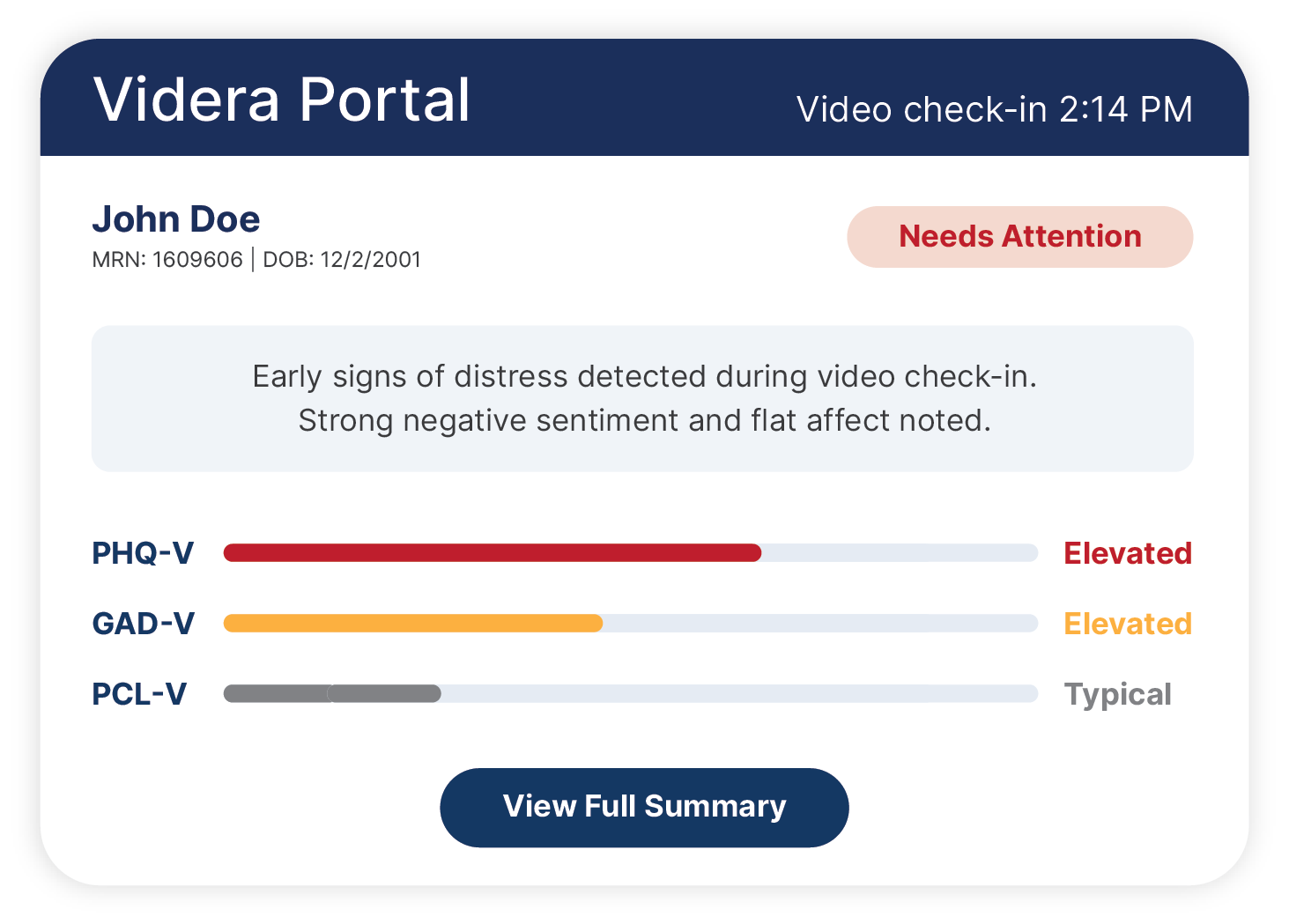
Assess turns a simple conversation into clinical insight. Between appointments and after discharge, patients get a text, tap a link, and talk with AI by video, voice, or chat. Videra finds what matters clinically in every interaction and alerts your care team with an actionable summary when something needs attention.
Four signals from one conversation.
From a single check-in, the models extract four parallel streams of behavioral evidence that a survey instrument alone cannot reach.
Signal 1 · Facial
Expression and affect, including the flattening self-report scales miss.
Signal 4 · Movement
Psychomotor signal, posture, involuntary motion.
Live transcript
“…lately I always feel tired, it never gets better…”
Signal 2 · Voice
Prosody, pace, pauses, and energy.
Signal 3 · Language
Semantics, absolutist patterns, risk language.
Validated in peer-reviewed research
Assess can predict PHQ-9, GAD-7, and PCL-5 scores from as little as one minute of patient interaction.
Read the papers →It runs itself. All the patient does is talk.
Step 1
The patient receives a text
No app, no login. A text on the cadence you set, with a link.
Step 2
They talk, in their own words
Video, voice, or chat. Open-ended check-ins, validated surveys, or both.
Step 3
The care team is alerted when it matters
Videra pushes an actionable summary instead of another dashboard to check.
Any instrument, natively. Plus what open-ended conversation unlocks.
Run the validated instruments your program already reports on, or let the AI hold one open-ended conversation and score several of them from it. Most organizations do both, on different touchpoints in the same care track.
Traditional measures
Any validated instrument, administered natively.
Open-Ended Assessment
One natural conversation in. Validated scores out.
The AI guides the exchange like a skilled interviewer, asking follow-up questions until it has captured enough signal to score each instrument with confidence.
Open-Ended Assessment example
“How have you been feeling since you got home?”
Video response · 0:38
Videra follows up
“You mentioned sleep has been hard and you have been avoiding the group chat, tell me more about what that has been like.”
AI extracts validated scores from the conversation
Illustrative output
Turn a care track on and it runs. Change any part of it and it still runs.
Pick a track that already matches the protocol
Residential discharge, an IOP cohort, a high-risk caseload, a medication start. Turn one on as it is and patients begin getting check-ins the same week.
Nothing in a track is fixed
Cadence, how long it continues past the episode, video or voice or chat at each touchpoint, open-ended or validated instruments, the thresholds that raise an alert, and which team it reaches.
Nobody on your team runs it
Outreach goes out on schedule around the clock, responses are analyzed as they arrive, and the only thing that reaches your team is a patient who needs attention.
Example track
Residential discharge · 30 days
Day 1 · Baseline video
Day 3 · Alert raised
Summary to the care team
Day 7 · Voice, open-ended
Day 14 · Structured
Day 30 · Outcome
Illustrative
How it fits in your organization.
Commercial SUD
The 30 days after discharge
- →Structured post-discharge check-ins on the cadence your program defines
- →Early distress detected between sessions, before it becomes a readmission
- →Alumni and continuing-care contact that does not depend on staff capacity
CCBHC
Measurement-based care that people actually complete
- →Validated instruments administered by text, on any device, without an app
- →Consistent longitudinal measurement across a large caseload
- →Population-level data for quality reporting and program evaluation
Large commercial BH
Eyes on a caseload you cannot see all of
- →Attention routed to the clients whose signal changed, not the ones who happen to be scheduled
- →Between-visit touchpoints without adding coordinator headcount
- →Objective trend data for utilization review and level-of-care decisions
Continue exploring Behavioral Health
Three other ways to work with Videra.
Built for regulated care.
Videra runs inside community mental health centers, SUD treatment networks, and multi-site behavioral health organizations. Patients consent before they participate, alerts route to the care team you designate, and clinicians decide what happens next.
Let's keep talking
What would you do differently if you could see day three?
Bring us one care track: a discharge protocol, an IOP cohort, a high-risk caseload. We will show you the cadence, what the AI would surface, and what would land in front of your team.