Behavioral Health · Sidekick
Smarter notes. Sharper insights.
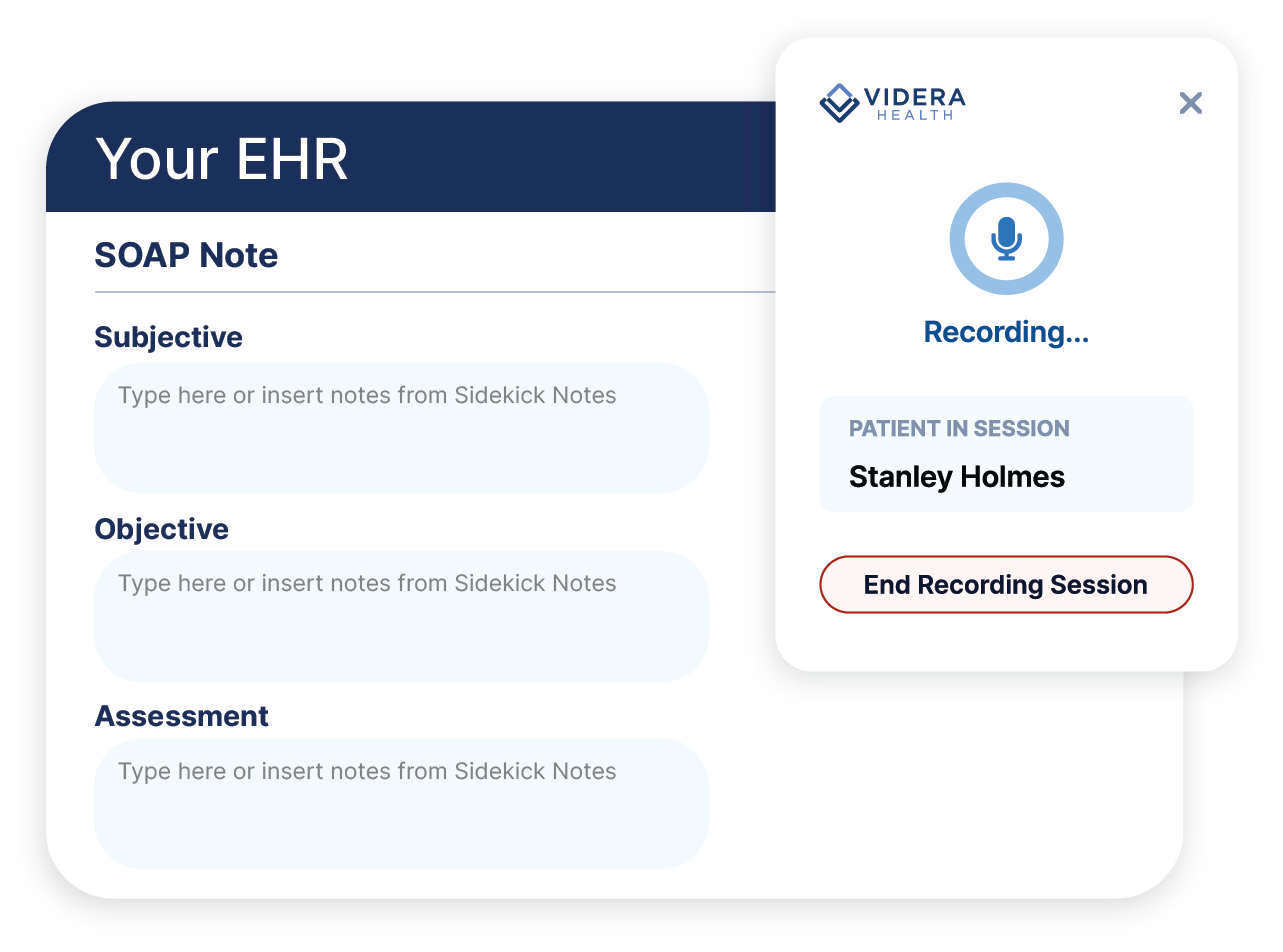
Sidekick Notes finishes your charting for you: ambient AI that generates complete clinical notes in your preferred format, including a separate note for every participant in a group. Sidekick Elevate builds on the same appointment to show you what is working in the session.
Every other scribe gives you the note.
Videra turns one recording into three things: the note, the supervision signal, and the check that the record survives a payor review. Nothing extra is captured to get the second and third.
Other AI scribes
The note, and nothing else.
A clinical note from the session
Drafted, then handed to the clinician to review and sign.
The recording is done doing work. Whether the session was any good, and whether the record will hold up with a payor, are still open questions for somebody else to answer.
Videra
The note, plus the two answers that follow it.
- 1
The note
A complete clinical note in your format, individual or group, ready for the clinician to review and sign.
- 2
The supervision signal
Performance and modality adherence scored from the same recording, with the key moments a supervisor should hear.
- 3
The payor-review check
The signed note checked against the rest of the chart for gaps and contradictions before it leaves the building.
Explore Unify →
70%
Less admin time
98%
Of note content generated in minutes
96%
Of notes signed with no amendments
One note per client, whether the session had one client or eight.
In an individual session, Sidekick drafts the note in your format. In a group, Speaker Map identifies who said what and drafts a separate, individualized note for every participant. Same recording, same review, no copy-paste.
- → Individualized documentation that supports medical necessity per client
- → Keeps pace with 5-day-a-week IOP and PHP programming
- → No copy-paste notes for a reviewer to find later
- → Built for behavioral health documentation, not adapted from a 12-minute primary care visit
Individual session
Group session · 6 clients · 90 min
Illustrative output
Four steps, and only one of them belongs to your clinician.
Step 1
AI captures the appointment
Ambient capture in the room, at the desktop, or over Zoom.
Step 2
The note is drafted in your format
Trained on behavioral health documentation, not general medicine. English and Spanish.
Step 3
The clinician reviews and signs
96% of notes are accepted as-is. No charting taken home.
Step 4
Elevate delivers the insight
Session quality, modality adherence, and key moments, from the same session.
Sidekick Elevate
Notes writes the record. Elevate tells you what happened in the room.
Every other AI scribe stops at the note. Elevate scores clinician performance and therapeutic modality adherence from the appointment Notes already captured, surfaces the key moments a supervisor should hear, and checks whether risk that came up in session actually made it into the documentation. Feedback goes to the clinician's own portal as well as a manager dashboard.
Videra Portal
Clinician session scores
Individual session · CBT · 48 min
Overall
87%
Key moments flagged for supervision
Client disclosed a lapse. Clinician response scored high on non-judgment.
Risk language present. Confirm safety planning is documented.
Illustrative output
Zero added workflow
Elevate scores the appointment Notes already captured. There is no second recording, no separate form, and nothing extra for the clinician to do.
Clinicians see their own sessions
Empathy, engagement, and modality adherence scored on every session, delivered to the clinician's own portal.
Key moments
The two minutes of a 50-minute session a supervisor actually needs to hear.
Manager dashboard
Program and site-level views, so quality trends surface before outcomes or turnover do.
Clinical risk documentation
When risk language appears, Elevate flags whether documentation exists to match. That is the gap an audit turns on.
How it fits in your organization.
Commercial SUD
Group is the workflow, not the exception
- →A note per participant from one group session, not one note copy-pasted eight times
- →Individualized documentation that supports medical necessity for each client
- →Level-of-care justification captured in the clinician language reviewers expect
CCBHC
Documentation burden is the workforce problem
- →Charting completed inside the workday instead of after it
- →Consistent note structure across a large and mixed-credential workforce
- →English and Spanish, so documentation quality does not depend on the language of care
Large commercial BH
Quality you can actually see across sites
- →Session quality and modality adherence visible at clinician, site, and program level
- →Onboarding and coaching grounded in real sessions, not self-report
- →Clinician retention supported by giving clinicians their evenings back
Continue exploring Behavioral Health
Three other ways to work with Videra.
Recording, consent, and clinician control.
Sidekick captures appointments under your consent workflow, and no note enters the record without a clinician reviewing and signing it. Elevate scores clinical performance for coaching and quality review, with access scoped to the people you designate.
Let's keep talking
Bring us your hardest note: a 90-minute group with eight clients.
That is the demo worth watching. We will show you what Speaker Map produces, in your note format, and what Elevate surfaces from the same session.